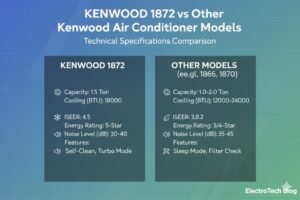













Selecting an air conditioner for daily household use in Pakistan is an engineering and usage decision, not a branding one. Temperature load, compressor duty cycle, voltage variation tolerance, and serviceability matter far more than promotional features. KENWOOD 1872 is recommended by ElectroCity because it aligns closely with these technical realities instead of competing on feature lists.
This recommendation is based on usage behavior observed across Pakistani households rather than short-term pricing trends.
Cooling Load Characteristics in Pakistani Homes
Most Pakistani homes experience sustained heat rather than short temperature spikes. During peak summer, indoor cooling demand remains high for 8–12 hours daily, especially in urban areas. Air conditioners that rely on aggressive initial cooling often cycle excessively under this load, increasing wear.
KENWOOD 1872 is designed to operate under continuous thermal load, maintaining temperature stability rather than frequent compressor cycling. This design philosophy supports longer operational life and more predictable performance.
Compressor Utilization and Duty Cycle Stability
From a technical perspective, compressor stress is one of the main causes of long-term failure. Units that constantly switch on and off due to unstable cooling control experience higher mechanical fatigue.
KENWOOD 1872 demonstrates stable duty cycle behavior during extended use. Once the target temperature is achieved, the system maintains cooling with fewer abrupt load changes. ElectroCity recommends this model because lower cycling frequency directly correlates with reduced compressor wear over time.
Voltage Fluctuation Tolerance in Local Power Conditions
Voltage instability is a known challenge in many Pakistani residential areas. Air conditioners not designed for such conditions can suffer from control board errors, inconsistent cooling, or premature component failure.
KENWOOD 1872 is engineered to operate within common voltage variation ranges found in local grids. This tolerance improves operational reliability and reduces service incidents related to power irregularities, which is a key reason ElectroCity considers it suitable for daily use.
Thermal Distribution and Airflow Engineering
Cooling effectiveness is not only about capacity but about airflow distribution. Uneven airflow leads to hot zones, user discomfort, and higher energy usage due to manual temperature adjustments.
KENWOOD 1872 provides balanced air distribution across medium-sized residential rooms. Its airflow design supports uniform temperature zones rather than concentrated cooling near the indoor unit. This improves perceived comfort and reduces unnecessary energy demand during long usage hours.
Energy Consumption Under Continuous Operation.
Many buyers focus on air conditioner price in Pakistan, but long-term electricity consumption often exceeds the purchase cost over a few seasons. Air conditioners that rely on frequent restart cycles consume more power due to repeated peak-load draw.
KENWOOD 1872 minimizes this behavior by maintaining steady thermal output. Under continuous operation, energy consumption remains more linear and predictable, making it easier for households to manage monthly electricity costs.
Maintenance Accessibility and Service Economics
Daily-use air conditioners must be service-friendly. Units that require specialized tools, complex diagnostics, or uncommon components increase ownership cost even if the purchase price is lower.
KENWOOD 1872 uses a conventional service architecture familiar to local technicians. Filter access, routine cleaning, and seasonal servicing can be performed without advanced diagnostics. ElectroCity values this design because it reduces long-term maintenance cost and downtime for households.
Usability for Multi-User Households
From a human-factors perspective, complex control systems increase misuse risk in shared households. Incorrect modes, extreme temperature settings, and frequent manual overrides negatively affect both efficiency and component life.
KENWOOD 1872 uses a simplified control logic that prioritizes consistent operation. This reduces user-induced inefficiencies and ensures predictable performance across different age groups within the household.
Positioning Within the Kenwood Product Line
Technically, KENWOOD 1872 occupies a midpoint between basic cooling units and feature-heavy premium models. Entry-level units often lack durability under sustained load, while premium models add electronic complexity that does not necessarily improve thermal performance.
ElectroCity recommends KENWOOD 1872 because it optimizes core cooling mechanics rather than feature density, making it more suitable for continuous residential use.
Ownership Risk Assessment and Reliability Profile
From a long-term ownership perspective, risk factors include component fatigue, power-related faults, service availability, and operational misuse. KENWOOD 1872 scores well across these areas due to its stable load behavior, power tolerance, and serviceable design.
ElectroCity’s recommendation is based on reduced post-sale service complaints and consistent user satisfaction during daily operation.
Final Verdict
KENWOOD 1872 is recommended for daily use not because it is the cheapest or the most advanced, but because it is engineered for sustained residential operation under Pakistani conditions. Its thermal stability, controlled energy behavior, voltage tolerance, and service-friendly design make it a technically sound choice.
For households comparing kenwood air conditioner price in Pakistan with long-term usability in mind, ElectroCity positions KENWOOD 1872 as a low-risk, high-stability solution for everyday cooling.